Jumat, 15 September 2006

The European Influence

The first Dutch seamen set foot on Bali in 1597, yet it wasn't until the 1800's that the Dutch showed an interest in colonizing the island. In 1846, having had large areas of Indonesia under their control since the 1700's, the Dutch government sent the troops into northern Bali. In 1894, Dutch forces sided with the Sasak people of Lombok to defeat their Balinese rulers. By 1911, all the Balinese principalities had either been defeated in battle, or had capitulated, leaving the whole island under Dutch control. After World War I, Indonesian Nationalist sentiment was rising and in 1928, Bahasa Indonesia was declared the official national language. During World War II, the Dutch were expelled by the Japanese, who occupied Indonesia from 1942 to 1945.

After the Japanese defeat, the Dutch tried to regain control of their former colonies, but on August 17, 1945, Indonesia was declared independent by its first President, Sukarno. After four years of fighting and strong criticism from the international community, the Dutch government finally ceded and, in 1949, Indonesia was recognized as an independent country.

Bali Cultur

Although there are no artifacts or records dating back to the Stone Age, it is believed that the first settlers on Bali migrated from China around 2500 BC. By the Bronze era, around 300 B.C. quite an evolved culture existed in Bali. The complex system of irrigation and rice production, still in use today, was established around this time.

History is vague for the first few centuries. A number of Hindu artifacts have been found dating back to the 1st century, yet it appears that the main religion, around 500 AD was predominantly Buddhist in influence. A Chinese scholar, Yi-Tsing, in 670 AD reported on a trip to India, that he had visited a Buddhist country called Bali.

It wasn't until the 11th century that Bali received the first strong influx of Hindu and Javanese cultures. With the death of his father around AD 1011, the Balinese Prince, Airlanggha, moved to East Java and set about uniting it under one principality. Having succeeded, he then appointed his brother, Anak Wungsu, as ruler of Bali. During the ensuing period there was a reciprocation of political and artistic ideas. The old Javanese language, Kawi, became the language used by the aristocracy, one of the many Javanese traits and customs adopted by the cause.

With the death of Airlanggha, in the middle of the 11th century, Bali enjoyed a period of autonomy. However, this proved to be short-lived as in 1284, the East Javanese king Kertanegara, conquered Bali and ruled over it from Java. In 1292, Kertanegara was murdered and Bali took the opportunity to liberate itself once again. However, in 1343, Bali was brought back under Javanese control by its defeat at the hands of Gajah Mada, a general in the last of the great Hindu-Javanese empires, the Majapahit. With the spread of Islam throughout Sumatra and Java during the 16th century, the Majapahit Empire began to collapse and a large exodus of aristocracy, priests, artists and artisans to Bali ensued. For a while Bali flourished and the following centuries were considered the Golden Age of Bali's cultural history. The principality of Gelgel, near Klungkung, became a major centre for the Arts, and Bali became the major power of the region, taking control of neighboring Lombok and parts of East Java.

Jumat, 08 September 2006

Recreation list in Bali

  • Kuta Beach
  • Sanur Beach
  • Nusa Dua and Tanjung benoa Beach
  • Sangeh
  • Serangan Island
  • Elaphant Cave
  • Nusa Peninda Island
  • Uluwatu Tample
  • Kintamani

Kamis, 24 Agustus 2006

Shopping in Bali

Bali is known as a treasure house of interesting goods to buy. Products of various kinds from traditional antiques to the latest quality fashions in extraordinary displays await the shoppers. It is quite common to bargain in markets, shops and art shops for buyers, so having a good price is partly dependent upon one's smartness in bargaining. Splendid local hand woven materials, silver and gold works, woodcarvings, garments and many other interesting things can be found at any market, art shop or art market. International standard ready made apparels are quite
inexpensive, while qualified tailors and dress makers offer reliable 24-hours services.

Bargaining forms a large part of the fun of shopping in Bali. Remember to bring your cash, as not all places accept credit cards. Shopping hours are generally from 10am to 10pm.

You'll find that shops selling similar items are generally grouped together. This makes comparing prices easy as you just have to go to the next shop to find the same thing!


Rabu, 23 Agustus 2006

Nusa Dua

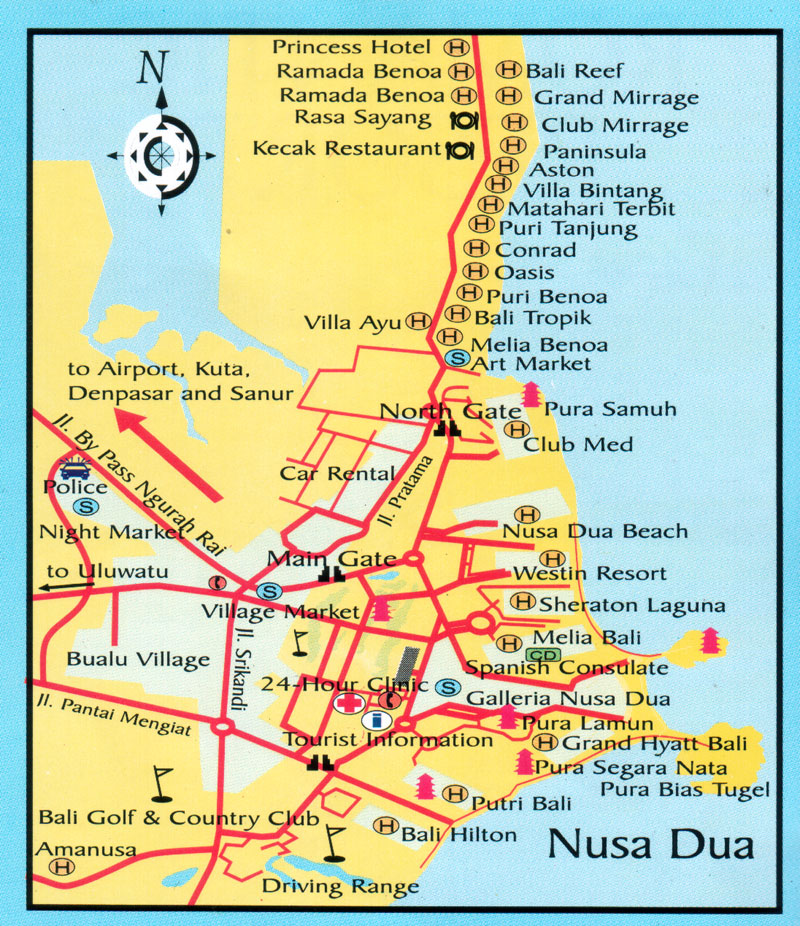
Crystal clear water and stretches of white sandy beach of Nusa Dua makes Nusa Dua a perfect spot for luxurious resorts to which your exhausted bodies, after a Barong performance at Batubulan and a long climb of the steps of the Mother Temple Besakih, will want to rest. Some of the most sumptuous and luxurious hotels in the world find their home in Nusa Dua Bali. You can relax in the Thalasso spa of the Grand Mirage Resort after a day of surfing or diving. Or you can tee off into the sunset, while watching the gentle waves come from the blue sea and caress the banks surrounding the luscious greens. Tranquil swimming pools under the coconut trees seem to be one with the distant blue sea. Art galleries and numerous shops surround them.

In Bali, Nusa Dua is the place to stay in style.


Nusa Dua map

Bali Island

Bali, a tropical island in the Indonesian archipelago, is so picturesque and immaculate it could almost be a painted backdrop. It has rice paddies tripping down hillsides like giant steps, volcanoes soaring up through the clouds, dense tropical jungle, long sandy beaches, warm blue water, crashing surf and friendly people who don't just have a culture but actually live it. In Bali spirits come out to play in the moonlight, every night is a festival and even a funeral is an opportunity to have a good time.

Bali Island, the perfect holiday destination for all ages offers something for everyone. This tropical paradise has a unique blend of modern tourist facilities combined with wonderful shopping and a rich past and heritage. The Balinese people are proud of having preserved their unique Hindu culture against the advance of Islam, the dominant religion throughout Indonesia. This is still reflected in day to day life and can be seen in the numerous ceremonies, Balinese festivals and magnificent temples and palaces. Some of the best surfing beaches in the world can be found on the western side of the island whilst conversely the eastern side is a wonderful haven for families, with beautiful white sand beaches and gentle seas.

Bali Island is a shopper's paradise particularly for casual and tailored clothing, locally made jewellery, handicrafts, antiques and artifacts. Leather ware is one of the unexpected local bargains with everything from handbags through to tailor made leather jackets and coats, all at unbelievable prices. In fact, prices are so inexpensive, you're sure to need more room in your suitcase! Try bargaining at the street markets of Kuta, Sanur of Nusa Dua or fixed price shopping at a Denpasar department store. Bali has it all.

For those that want to stay wet, Bali Island has world class scuba diving, snorkelling and wonderful day trips out to Nusa Penida for beach sports and coral viewing.

When the sun sets, the choices are still hard to make - a quiet romantic moon lit dinner or watch the spectacular Balinese Fire Dance or Kecak Dance. For those that want to party, Bali Island has it all with bars, discos and nightclubs.

As a truly international destination attracting visitors from all over the world, restaurants in Bali are extremely cosmopolitan yet inexpensive. Experience not only local delicacies like Nasi Goreng and Sate Campur but also Chinese, Malaysian, Japanese, Italian/European Greek, Moroccan and even Mexican cuisine. We must not forget Bali's wonderful seafood - local lobster at such prices that you will want to keep coming back for more.

For those more culturally inclined, Bali can offer the peace and tranquility of Ubud high in the hills; the spectacular Mother Temple at Besakih; the ancient capital of Bali, Singaraja and the floating palace at Ujung near the pretty beach area of Candi Dasa. The Scenery is nothing less than spectacular. Jungle, picturesque hillside rice terraces and the awesome magnificence of Kintamani Volcano.

The more active, wanting a break from the idyllic beaches, can experience wonderful golf courses in the mountains at Bedugul and beachside at Nusa Dua, the thrill of white water rafting or kayaking down the beautiful Ayung River; mountain cycling amid scenery you will never forget and organized rice paddy and jungle treks to see the side of Bali most tourists never encounter.
Bali Island, a truly international destination, offers every standard of accommodation ranging from charming yet modest bungalow style hotels in lush tropical gardens for the budget minded through to arguably amongst the most exclusive and sophisticated hotels in the world!